Poison Tree Tattoo Meaning: Symbolism & Design Ideas
What Does a Poison Tree Tattoo Really Mean? Full Symbolism Guide
You keep seeing a twisted tree bearing a single apple inked on skin, and it intrigues you. The design feels darker than typical nature tattoos, but the true message escapes you. Without the backstory, that ink remains just a creepy tree. This guide unearths the poison tree tattoo meaning, tracing every root back to William Blake’s haunting poem so you grasp exactly what you’re wearing or admiring.
The William Blake Poem That Defines the Poison Tree Tattoo Meaning
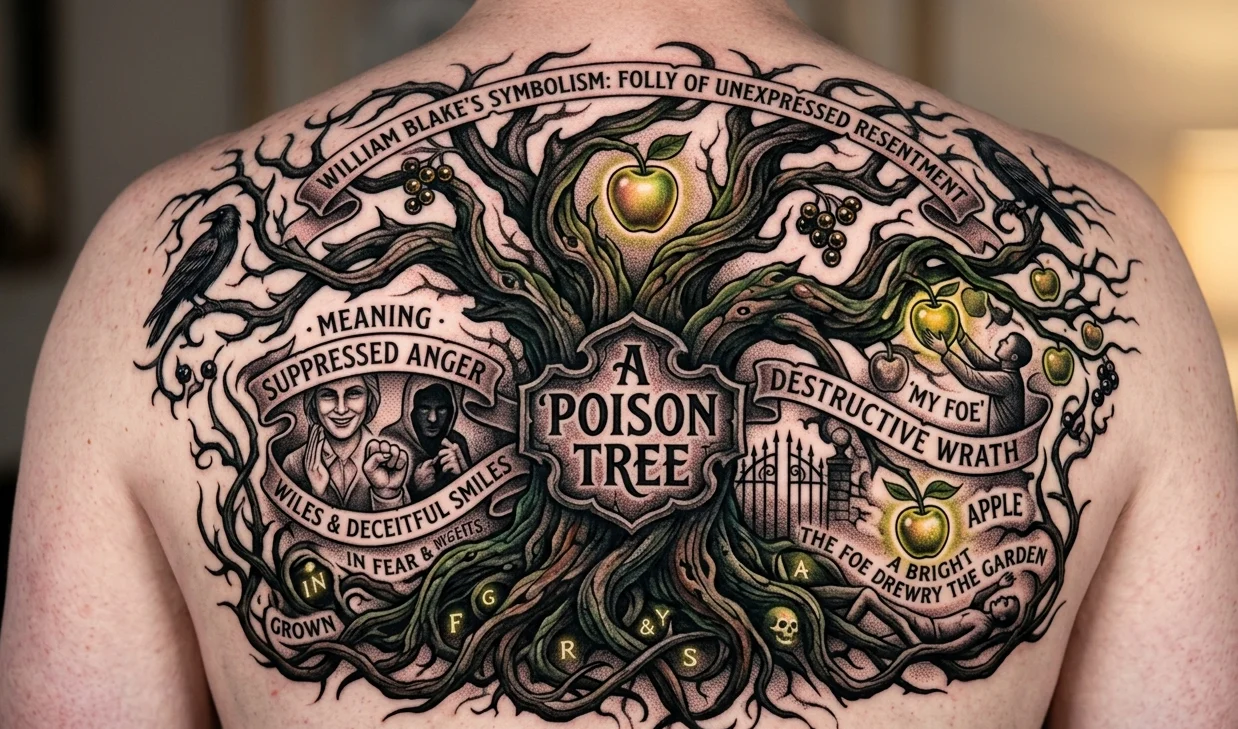
William Blake published “A Poison Tree” in 1794 as part of his Songs of Experience collection. The poem narrates a speaker who confesses anger to a friend, resolving the conflict, but hides wrath from a foe. That unspoken rage festers and grows into a tree bearing a bright apple. The foe, greedy for the fruit, steals it under cover of night and dies beneath the tree’s shadow. The poison tree tattoo meaning draws directly from this narrative—it visualizes the poem’s core warning.
Blake’s verse runs just sixteen lines, yet every word feeds into the ink interpretations. When a tattoo captures a gleaming apple hanging over a corpse or a serpent coiled around the trunk, it directly references the fatal temptation in the final stanza. The poison tree tattoo meaning rests on this literary foundation first, not just generic gothic aesthetics. Tattoo artists familiar with Romantic poetry consciously embed these references, and clients who carry the design often connect with the poem’s emotional truth about concealed anger.
Core Symbolism: Wrath, Deceit, and the Poisoned Apple
Three emotions drive the poison tree tattoo meaning: suppressed anger, deliberate deception, and poisonous sweetness. The speaker waters the tree with “fears” and suns it with “smiles,” a chilling metaphor for friendly facades masking hatred. A tattoo of the tree in full bloom with a glossy apple serves as a permanent reminder that hidden wrath grows into something lethal.
The apple itself carries multiple layers. In Blake’s poem, it mirrors the fruit from the Garden of Eden—beautiful, desirable, and deadly. The foe sees the apple, craves it, and steals it, unaware it will kill him. A poison tree tattoo meaning often speaks to awareness of one’s own capacity for passive aggression. People get this design after surviving toxic workplaces, backstabbing friendships, or relationships where smiles masked true intentions. The imagery forces a confrontation with an uncomfortable truth: we can all grow poison trees.
The tree’s roots also matter. In many designs, thick, knotty roots represent buried grievances that never got voiced. The trunk, often depicted with thorns or jagged bark, stands for the hardened heart that forms when anger stays bottled up. When you combine these elements, the poison tree tattoo meaning becomes a psychological map—a visual warning against emotional dishonesty.
Poison Tree Tattoo Meaning in Relationships and Toxic Bonds
Couples and friends sometimes use this tattoo to mark a shared journey through betrayal or to pledge honesty. The poison tree tattoo meaning within relationships highlights what happens when partners smother their true feelings. One person waters silent resentments while the other remains oblivious, until the relationship collapses under the weight of unspoken words.
Some survivors of emotional abuse choose the design as a reclaiming symbol. They view the tree not as their own inner poison, but as the abuser’s tactics—the sweet apple offered publicly while the roots poisoned everything underneath. This dual interpretation gives the tattoo immense personal versatility. A poison tree with a cracked trunk and a fallen apple might signal the end of a toxic cycle, while a full, vibrant tree with a skull at its base warns of ongoing danger. The poison tree tattoo meaning bends to fit the wearer’s story, which explains its popularity among people processing complex grief and relational trauma.
Bitter Fruit and Temptation: Biblical and Mythological Ties
Blake didn’t invent the poison tree out of nowhere. The poison tree tattoo meaning connects to older mythic narratives. The Tree of Knowledge of Good and Evil in Genesis offers the closest parallel—one tree, one forbidden fruit, and catastrophic consequences. Tattoo designs that replace the apple with a pomegranate or fig merge Blake’s vision with Eden’s fall, layering original sin onto the theme of hidden wrath.
In Norse mythology, the world tree Yggdrasil has roots gnawed by serpents and dragons. A poison tree tattoo might blend Nordic knotwork with a serpent winding up the trunk, symbolizing the rot that hidden venom brings to the entire self. Greek mythology contributes the concept of the Upas tree, a fabled tree so poisonous it kills everything around it. During the 18th century, Europeans believed the Upas tree existed in Java, and Blake may have drawn partial inspiration from those tales. The poison tree tattoo meaning thus stretches across cultures, always circling back to a central truth: what looks enticing can destroy.
Common Design Elements and Their Specific Meanings
| Design Element | Symbolism in Poison Tree Tattoo Meaning |
|---|---|
| Glowing Apple | Temptation, the lure of revenge, sweetness hiding poison |
| Coiled Serpent | Deception, the voice of the enemy, Satanic influence |
| Skull at Base | Fatal outcome of suppressed anger, death of innocence |
| Thorny Branches | Defensiveness, sharp words unsaid, self-protection |
| Watering Can or Tears | Nurtured grievances, the speaker’s “tears” that feed the tree |
| Crescent Moon | Secrecy, the night the foe stole the fruit |
| Split Trunk | Divided self, the public smile versus private rage |
| Raven or Crow | Omen of death, dark thoughts, messenger of hidden truths |
These elements never appear randomly. Tattoo artists who understand the poison tree tattoo meaning use each symbol to reinforce the narrative. A client wanting to emphasize self-destruction might request roots that choke a heart. Another seeking to highlight the moment of confrontation might show a hand reaching for the apple. The combination possibilities feel endless, making every poison tree tattoo a unique psychological self-portrait.
Color Choices That Reinforce the Poison Tree Tattoo Meaning
Black and grey designs dominate, creating a somber, etching-like quality that mirrors Blake’s original illustrated plates. A monochrome poison tree focuses attention on texture and shadow, making the apple look like a hole in the skin. However, some wearers demand color to push specific meanings. A deep crimson apple signals passion and danger simultaneously. Sickly yellow-green leaves suggest decay and venom. A background wash of murky purple conjures a twilight, magical-realism mood where poison and enchantment blur.
Watercolor techniques have grown popular for this subject, with splashes of red and orange bleeding beyond the tree’s outline like the anger finally leaking out. White ink highlights on the apple create an unnatural glow, emphasizing the supernatural lure. Every color decision deepens the poison tree tattoo meaning, so spend time discussing palette choices with your artist.
Best Placements for a Poison Tree Tattoo
The poison tree tattoo meaning influences where on the body the design lands. A vertical forearm placement reads like a page from Blake’s book, the tree growing upward with each glance. Ribcage placements allow the roots to spread across your side, suggesting hidden depths beneath the surface. A back piece turns your spine into the trunk, making you physically embody the tree’s structure. This full-back option works best for large, detailed compositions featuring multiple poem elements.
Thigh pieces suit apple-centric designs, with the fruit sitting prominently and the branches wrapping around the leg. For smaller, more discreet reminders, wrists and behind-the-ear spots hold minimalist poison trees—just a thin trunk, a few leaves, and a single bright apple. Ankle and foot placements can symbolize the tree’s grounding, the poison rooted in the earth. No matter where the needle hits, the poison tree tattoo meaning travels with you, a walking invitation to conversations about honesty and emotional health.
The Poison Tree Tattoo Meaning for Men vs. Women
Men often gravitate toward darker, bolder interpretations with thick linework, skulls, and serpents, emphasizing the destructive consequences of wrath. Women frequently incorporate botanical precision, detailed foliage, and softer touches like flowers blooming on the poisoned branches—hinting at growth emerging from toxicity. These aren’t rules, but patterns observed across thousands of designs shared online. The poison tree tattoo meaning resonates regardless of gender because hidden anger knows no boundaries.
Non-binary and genderfluid clients often subvert both approaches, pairing geometric elements with organic shapes to represent a mind-body disconnect healed through confronting past poison. Every variation circles back to the same poem, but the expression twists through identity, experience, and aesthetic preference. The best artist consults deeply with you to align the design with your specific relationship to the poison tree tattoo meaning.
Combining a Poison Tree with Other Tattoo Motifs
A poison tree rarely exists as a standalone image in modern tattoo culture. Many pair it with a quote from Blake’s poem, the most popular line being “I told it not, my wrath did grow.” Hand-lettered script curling around the trunk or roots adds literal meaning. Other combinations include a broken chain near the tree base to represent breaking free from toxic cycles, or a phoenix rising above the canopy to show rebirth after acknowledging buried anger.
Dagger-through-the-heart motifs intersect with the poison tree when the apple becomes the heart. A clock face merged with the tree trunk connects the poison tree tattoo meaning to the passage of time, warning that resentment compounds daily. Some designs split the composition between day and night, the sunlit side showing a smiling face and the moonlit side revealing the poison tree, mirroring the public-versus-private self described in the poem. These mashups demand an artist who reads the source material and thinks narratively.
Artists Known for Dark Botanical and Literary Tattoos
Finding the right needle matters. Several tattoo artists have built reputations specifically around literary and dark botanical designs. UK-based artist Grace Neutral incorporates fine-line poison tree imagery into her delicate neo-gothic style. American traditionalists like Paul Dobleman often reference vintage book illustrations, producing bold poison tree designs with heavy shading. Korean tattooist Oozy excels at blackwork apple trees with macabre twists.
When you search for an artist, ask to see examples of narrative tattoos—pieces that tell a story in a single image. Share Blake’s poem with them so they understand the poison tree tattoo meaning beyond a surface level. Artists who love literature will geek out on the project and pour genuine passion into the ink, resulting in a piece that carries emotional weight for decades.
How to Personalize Your Poison Tree Tattoo Design
The most powerful poison tree tattoos add personal biography to the poem’s skeleton. One approach involves replacing the apple with an object tied to your own suppressed conflict—a wedding ring, a key, a letter. Another method uses the tree as a memorial, carving initials into the bark to represent someone whose hidden actions poisoned a relationship permanently. You might incorporate the exact number of leaves matching years you spent in a toxic environment.
Personalization also extends to cultural roots. A poison tree designed in the style of Japanese ukiyo-e prints adapts the meaning to themes of vengeance and honor. Celtic knotwork around the trunk ties the poison tree tattoo meaning to ancestral stories of betrayal and tribe loyalty. The poem opens the door; your life story walks through it. Spend a week journaling about what anger you still water, then bring those notes to your consultation. That homework transforms a literary reference into an autobiography.
Psychological Power: What Wearing a Poison Tree Says About You
Choosing a poison tree tattoo signals self-awareness. You recognize that you harbor the capacity for quiet destruction, and you choose to wear that flaw openly. This honesty acts as a behavioral anchor. Every time you glance at your forearm or catch the design in a mirror, the poison tree tattoo meaning reminds you to voice your anger constructively. It functions like a memento mori for emotions—a death warning against smiling hatred.
Psychologists note that externalizing internal conflicts through art reduces rumination. A tattoo drawn from Blake’s poem takes a messy, hidden emotion and frames it as a complete narrative. The poison tree tattoo meaning then transforms from a shameful secret into a visible part of your identity, decreasing its power over your actions. Many wearers describe a release after getting the ink, as if they finally named something that had haunted them silently for years. This therapeutic dimension elevates the design beyond mere body art.
Frequently Asked Questions
What does a poison tree tattoo symbolize?
A poison tree tattoo symbolizes suppressed anger, deception, and the destructive consequences of nurturing hidden hatred. The poison tree tattoo meaning comes directly from William Blake’s poem, where a speaker’s unspoken wrath grows into a tree that kills his foe with a poisoned apple.
Is the poison tree tattoo meaning always negative?
Not entirely. While the poem ends in death, many wearers interpret the poison tree tattoo meaning as a warning to practice emotional honesty. It can represent breaking cycles of silent resentment, making the design a positive reminder to communicate openly before poison takes root.
What poem inspired the poison tree tattoo meaning?
William Blake’s “A Poison Tree” from his 1794 collection Songs of Experience provides the direct literary inspiration. The sixteen-line poem details how concealed anger matures into a deadly tree bearing a fatal apple, forming the entire foundation of the poison tree tattoo meaning.
Can a poison tree tattoo represent growth?
Yes. Some people view the poison tree tattoo meaning as representing growth through acknowledging darkness. The tree itself flourishes because the speaker tends it with tears and fears. Recognizing that you have the capacity to grow poison makes you more mindful of what emotional seeds you plant.
Where should I place a poison tree tattoo?
Common placements include the forearm, which allows the tree to read vertically like a poem stanza, and the ribs, where roots can spread across your side. Thigh, back, and calf placements also work well because they give the artist space to include detailed elements like apples, skulls, and serpents.
How do I ensure my poison tree tattoo is unique?
Customize the design with personal symbols tied to your experiences. Replace the apple with an object relevant to your own suppressed conflict, incorporate dates, or adjust the color palette to reflect your specific emotional journey. Work with an artist who understands the poison tree tattoo meaning deeply so they can craft a narrative piece unique to your story.
Your poison tree tattoo meaning doesn’t end with this article. It begins when you sit down with a skilled artist, Blake’s poem in hand, and map your own hidden groves onto skin. The ink becomes a living page from Songs of Experience, updated with your name, your ghosts, your lessons. Start by collecting design references that resonate, then book a consultation with an artist whose portfolio features dark narrative work. Share this guide with them, discuss which elements of the poem hit hardest, and let the needle turn suppressed words into something beautifully visible. The apple glows, the roots dig deep, and every time you catch your reflection, you’ll remember to speak your anger before it grows.