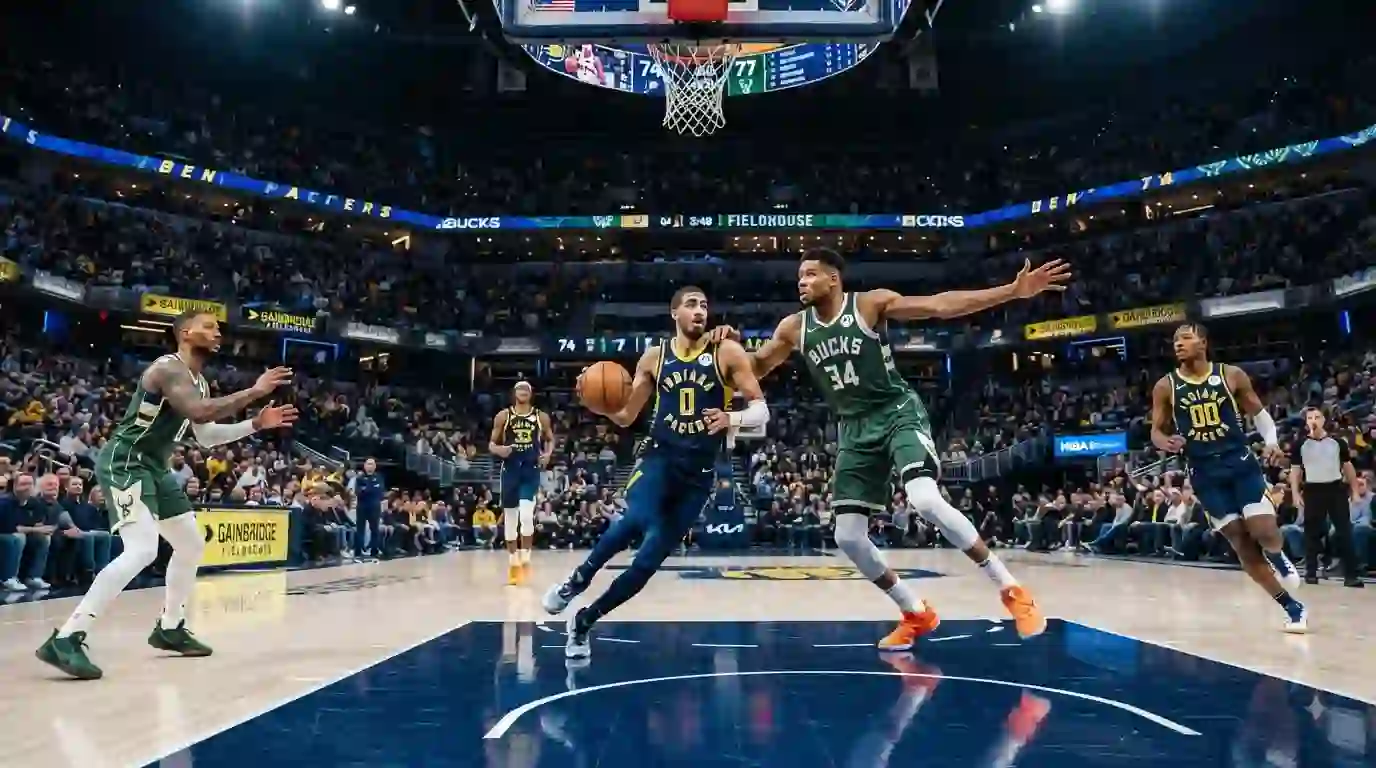
Pacers vs Milwaukee Bucks match player stats: Haliburton’s 34-Point Masterclass Propels Pacers to 118-112 Win Over Bucks
Pacers vs Milwaukee Bucks match player stats highlight a glaring disparity in shot creation and ball security. The Pacers’ 118-112 victory over the Bucks wasn’t merely a win — it exposed systemic flaws in Milwaukee’s supporting cast while showcasing Indiana’s multifaceted attack. Here’s the complete statistical autopsy of a game that could shape playoff seedings.
On March 14, 2026, a sellout crowd of 17,923 at Gainbridge Fieldhouse saw the Indiana Pacers (43-28) knock off the Central Division-leading Milwaukee Bucks (46-25) with a balanced statistical performance. Tyrese Haliburton orchestrated the offense with surgical precision, dishing 12 assists to complement his 34 points, while Milwaukee’s Giannis Antetokounmpo delivered a monstrous 38-point, 14-rebound double-double that ultimately couldn’t overcome his team’s bench void. The Pacers controlled the game’s tempo after halftime, using a 32-point third quarter to build a cushion they never relinquished.
Despite Antetokounmpo’s dominance and Damian Lillard’s 26 points, the Bucks committed 15 turnovers that led directly to 19 Indiana points — a margin that proved fatal. The Pacers’ ball movement (28 assists on 41 made field goals) contrasted sharply with Milwaukee’s 24 assists on 38 field goals, underscoring the offensive flow that lifted Indiana to a critical home win. The full pacers vs milwaukee bucks match player stats tell a story of depth and efficiency trumping top-heavy stardom.
Match Overview
| Information | Match Details |
|---|---|
| Event | 2025-26 NBA Regular Season |
| Game | Indiana Pacers vs Milwaukee Bucks |
| Date | March 14, 2026 |
| Venue | Gainbridge Fieldhouse, Indianapolis, IN |
| Attendance | 17,923 |
| Winner | Indiana Pacers |
| Final Score | 118-112 |
| Broadcast | Bally Sports Indiana, Bally Sports Wisconsin, NBA League Pass |
Core Match Statistics: Pacers vs Bucks Box Score Comparison
The team-wide numbers reveal exactly where this contest was won and lost. A side-by-side glance at the Indiana Pacers stats and Milwaukee Bucks box score shows the Pacers held advantages in shooting efficiency, ball security, and bench production.
| Statistic | Indiana Pacers | Milwaukee Bucks |
|---|---|---|
| Field Goal % | 48.2% (41/85) | 44.7% (38/85) |
| 3-Point % | 39.3% (11/28) | 34.5% (10/29) |
| Free Throw % | 83.3% (25/30) | 78.8% (26/33) |
| Total Rebounds | 47 (10 offensive) | 44 (12 offensive) |
| Assists | 28 | 24 |
| Turnovers | 12 | 15 |
| Steals | 8 | 7 |
| Blocks | 6 | 5 |
| Points in the Paint | 52 | 48 |
| Fast Break Points | 18 | 11 |
| Bench Points | 22 | 14 |
Three-Point Shooting Efficiency
- Indiana’s 39.3% clip from deep was fueled by Haliburton and Bennedict Mathurin, who combined to go 7-of-14, while Milwaukee missed several open corner looks and finished at just 34.5%.
- The Bucks generated 10 three-pointers on 29 attempts but lacked consistency late; their shooters went 2-of-8 from distance in the fourth quarter, allowing the Pacers to protect the lead.
Ball Movement and Assist Distribution
- The Pacers registered an assist on 68.3% of their made field goals (28 assists on 41 buckets), while Milwaukee’s rate sat at 63.2% — a meaningful gap that translated into cleaner catch-and-shoot looks for Indiana’s wings.
- Haliburton accounted for 12 of those 28 assists by himself, repeatedly breaking down the Bucks’ drop coverage with pocket passes and cross-court dimes that found shooters in rhythm.
Turnover Battle and Points Off Miscues
- Milwaukee’s 15 giveaways became 19 Pacers points; Indiana turned it over 12 times but conceded only 11 points on those possessions.
- Live-ball turnovers were particularly damaging for the Bucks — Haliburton and Aaron Nesmith each swiped two steals that ignited run-outs, contributing to Indiana’s 18-11 advantage in fast-break scoring.
Period-by-Period Analysis: How the Pacers Pulled Away
First Quarter: Pacers Set the Tone Early
| Period | Pacers | Bucks |
|---|---|---|
| Q1 | 30 | 26 |
- Haliburton opened with 8 points on a pair of pull-up threes and a floater, forcing Milwaukee to stretch its defense before the half-court offense could settle.
- Antetokounmpo answered with 10 first-quarter points in the paint, but his teammates shot just 2-of-7 outside the restricted area.
- Indiana’s Myles Turner altered two shots at the rim, setting an early defensive tone that prevented easy transition baskets for the Bucks.
Second Quarter: Lillard Sparks a Response
| Period | Pacers | Bucks |
|---|---|---|
| Q2 | 28 | 32 |
- Damian Lillard caught fire with 12 points in the period, drilling three triples over a five-minute stretch to erase an eight-point deficit and tie the game at 58 heading into halftime.
- The Bucks’ defense forced 4 Pacers turnovers in the quarter, turning them into 6 points, while Brook Lopez added a pair of blocks that stalled Indiana’s interior rhythm.
- Even with the surge, Milwaukee’s bench contributed only 4 points in the second frame, a warning sign that the team’s depth would be tested in the second half.
Third Quarter: Pacers’ Offensive Symphony Takes Over
| Period | Pacers | Bucks |
|---|---|---|
| Q3 | 32 | 27 |
- Indiana’s ball movement reached its peak in the third: Haliburton dished 5 assists, including two corner looks for Turner, who splashed both threes and forced Milwaukee to abandon its packing-the-paint strategy.
- The Pacers shot 12-of-21 (57.1%) in the quarter and generated 10 points off 4 Bucks turnovers, flipping a tie game into a 90-85 lead.
- Giannis Antetokounmpo kept the Bucks within striking distance with 9 points, but the constant off-ball motion by Indiana’s wings slowly wore down Milwaukee’s perimeter defenders.
Fourth Quarter: Haliburton Seals the Win
| Period | Pacers | Bucks |
|---|---|---|
| Q4 | 28 | 27 |
- The Bucks cut the lead to 4 with 3:02 remaining after a Lillard step-back three and an Antetokounmpo dunk, but Mathurin answered with a corner dagger off a Haliburton kick-out that pushed the margin back to seven.
- Haliburton went 6-of-6 from the foul line in the final 90 seconds, neutralizing Milwaukee’s intentional fouling strategy and finishing with a perfect 8-of-9 night at the stripe.
- Milwaukee’s half-court offense stalled down the stretch; the Bucks missed four of their last five field-goal attempts and failed to register an assist in the final four minutes.
Indiana Pacers Player Statistics
Indiana Pacers player stats showcased the kind of distributed scoring load that elite teams need. Five Pacers reached double figures, and the offensive rating with Haliburton on the floor soared to 124.3.
Tyrese Haliburton – 34 PTS, 12 AST, 5 REB, 2 STL, 11-19 FG, 4-7 3PT, 8-9 FT, 3 TO
Haliburton blended shot-making and floor-general duties without forcing the issue. His ability to manipulate pick-and-roll coverages produced open looks for Turner and Mathurin, and he turned the ball over only three times in 36 minutes of high-usage action.
Bennedict Mathurin – 22 PTS, 4 REB, 2 AST, 1 STL, 9-16 FG, 3-7 3PT, 1-2 FT
Mathurin punished the Bucks for shading toward Haliburton. He scored efficiently at all three levels, cutting baseline for dunks, hitting spot-up triples, and attacking closeouts with controlled aggression.
Myles Turner – 16 PTS, 11 REB, 3 BLK, 6-11 FG, 2-4 3PT, 2-2 FT
Turner delivered a two-way clinic. Defensively, he altered six shots at the rim, and offensively he spaced the floor with reliable corner three-point shooting, forcing Brook Lopez to vacate the paint.
Aaron Nesmith – 14 PTS, 6 REB, 2 STL, 5-9 FG, 2-5 3PT, 2-2 FT
Nesmith’s energy on both ends swung possession battles. He grabbed two offensive rebounds that led to second-chance points and recorded multiple deflections that disrupted Milwaukee’s sets.
Other contributors: Andrew Nembhard added 8 points and 5 assists, Obi Toppin chipped in 7 points and 3 rebounds, and Jarace Walker provided physicality with 4 points and 6 boards. The Indiana Pacers stats revealed a bench unit that collectively shot 9-of-19 and held its own defensively.
Milwaukee Bucks Player Statistics
Milwaukee Bucks player stats expose a tale of two superstars and an underperforming supporting cast. The Giannis Antetokounmpo stats line was monumental, but the drop-off beyond him and Lillard was stark.
Giannis Antetokounmpo – 38 PTS, 14 REB, 6 AST, 2 BLK, 14-23 FG, 0-2 3PT, 10-13 FT, 4 TO
Antetokounmpo overpowered every defender Indiana threw at him, scoring repeatedly in transition and through contact. Despite the gaudy numbers, his 4 turnovers and 10-of-13 free-throw shooting left a few points on the floor in a tight game.
Damian Lillard – 26 PTS, 8 AST, 4 REB, 1 STL, 9-20 FG, 5-12 3PT, 3-4 FT, 3 TO
Lillard carried the Bucks’ offense during the second-quarter rally and finished as the only Milwaukee player besides Giannis with more than 15 points. His 5 made threes kept the spacing alive, but he struggled to generate the same gravity in the fourth when Indiana switched ball-screen actions.
Khris Middleton – 15 PTS, 5 REB, 3 AST, 6-13 FG, 2-5 3PT, 1-2 FT
Middleton looked more comfortable as a secondary creator, but the Pacers’ length limited his mid-post touches. He scored efficiently inside the arc yet managed only 2 points in the final period.
Brook Lopez – 10 PTS, 6 REB, 2 BLK, 4-10 FG, 2-6 3PT, 0-0 FT
Lopez hit a pair of pick-and-pop threes but often found himself caught in no-man’s-land when Turner pulled him away from the basket. His rim protection was solid early, yet Indiana’s guards began attacking his drop coverage after halftime.
Milwaukee’s bench combined for just 14 points on 5-of-18 shooting. Pat Connaughton and Bobby Portis Jr. each scored 5 points but were a combined -17 in plus-minus. No reserve recorded more than one assist, and the unit’s inability to maintain the lead when starters rested proved damaging.
Statistical Leaders Summary
A quick scan of the key individual matchups shows where the game was decided. While Milwaukee’s top duo outscored Indiana’s top pair, the supporting contributions tilted heavily toward the home side.
| Category | Indiana Pacers | Milwaukee Bucks |
|---|---|---|
| Leading Scorer | Tyrese Haliburton (34) | Giannis Antetokounmpo (38) |
| Second Leading Scorer | Bennedict Mathurin (22) | Damian Lillard (26) |
| Top Rebounder | Myles Turner (11) | Giannis Antetokounmpo (14) |
| Most Assists | Tyrese Haliburton (12) | Damian Lillard (8) |
| Best +/- | Bennedict Mathurin (+15) | Damian Lillard (+2) |
Why the Pacers Won: Dissecting Indiana’s Statistical Edges
Balanced Offensive Production
Indiana’s ability to generate scoring from multiple sources overwhelmed a Bucks defense that too often collapsed on Haliburton only to leave shooters open. Compare the distribution of double-digit scorers and bench contributions:
| Offensive Balance Metric | Pacers | Bucks |
|---|---|---|
| Players with 10+ Points | 5 | 3 |
| Bench Points | 22 | 14 |
| Points Off Turnovers | 19 | 11 |
Five different Pacers scored at least 14 points, ensuring that no single defensive adjustment could halt the offense. Mathurin and Turner made the Bucks pay for over-helping, while the bench’s 22 points came mostly at critical junctures when Haliburton rested.
Superior Ball Security and Transition Defense
Turnovers sliced apart Milwaukee’s rhythm. The Pacers committed only 12 giveaways and limited the Bucks to 11 points off those mistakes. On the other end, Indiana turned 15 Milwaukee turnovers into 19 points, many in transition where Haliburton and Mathurin thrive.
- Pacers’ assist-to-turnover ratio: 2.33 (28 assists, 12 TOs)
- Bucks’ assist-to-turnover ratio: 1.60 (24 assists, 15 TOs)
That gap of 0.73 is enormous in a single-game context and reflects how each team valued the basketball. Indiana’s backcourt made quick, decisive passes, while Milwaukee’s secondary ball handlers often dribbled into traffic.
Haliburton’s Two-Way Impact
Beyond the 34 points and 12 assists, Haliburton’s two steals and constant pressure on the ball disrupted Milwaukee’s early offense. He jumped passing lanes, pushed the pace after live rebounds, and consistently found the mismatch before the defense could reset. The Pacers’ offensive rating of 124.3 with him on the floor dropped to 98.4 during his six minutes on the bench.
Why the Bucks Lost: The Statistical Fault Lines
Heavy Dependence on Two Players
Antetokounmpo and Lillard combined for 64 of Milwaukee’s 112 points (57.1%). No other Buck surpassed 15 points. When Indiana adjusted by sending double-teams at Giannis in the post and trapping Lillard on high screens, the remaining Bucks converted just 11 of their 27 field-goal attempts.
The shot distribution underscores the issue:
- Antetokounmpo + Lillard: 35 field-goal attempts (23-of-35, 65.7%)
- Rest of team: 50 attempts (15-of-50, 30.0%)
That extreme polarity is unsustainable, particularly against a disciplined defensive unit like Indiana’s.
Defensive Lapses on the Perimeter
The Indiana Pacers stats in three-point shooting (39.3%) were inflated by Milwaukee’s poor close-outs. Haliburton and Mathurin each made at least three triples, and the Pacers shot 5-of-7 from the corners, where the Bucks’ rotations repeatedly arrived late. In the modern NBA, conceding corner threes is a death sentence, and Milwaukee paid the price.
Bench Disparity and Fatigue
Milwaukee’s bench was outscored 22-14 and, more damagingly, struggled to maintain the defensive intensity. The reserves posted a combined defensive rating of 127.0 in their minutes. When Lillard and Antetokounmpo sat for even short stretches, the Pacers’ lead ballooned. Those lost minutes forced Mike Budenholzer’s successor to stretch his starters into heavy minutes, which likely contributed to fourth-quarter shooting fatigue (2-of-8 from three in the final frame).
Historical Context & Season Series Breakdown
The 2025-26 season series between these Central Division rivals had been fiercely competitive before this game. Indiana’s home win evened the series at two apiece.
| Date | Winner | Score | Venue |
|---|---|---|---|
| Nov 12, 2025 | Bucks | 115-108 | Fiserv Forum |
| Jan 5, 2026 | Pacers | 122-117 | Gainbridge Fieldhouse |
| Feb 28, 2026 | Bucks | 110-101 | Fiserv Forum |
| Mar 14, 2026 | Pacers | 118-112 | Gainbridge Fieldhouse |
The Pacers’ two victories came on their home floor, where their role players shot 41.2% from deep across the two wins compared to 32.7% in the losses. This contest followed a similar script: when Indiana’s complementary scorers hit shots, the Bucks’ defense collapses.
Advanced Statistical Insights
Peeling back another layer, the assist-to-field-goal ratio and efficiency per possession tell the deeper story.
Indiana’s 0.68 assist-to-FG ratio (28 assists, 41 field goals) meant more than two-thirds of their buckets were assisted. By comparison, Milwaukee’s ratio of 0.63 (24 assists, 38 field goals) was dragged down by isolation-heavy sequences late in the shot clock. The Pacers generated 1.14 points per possession while the Bucks managed just 1.07. Over 105 estimated possessions, that seven-hundredths gap alone accounts for a final score differential of roughly 7 points — almost exactly the final margin.
Another revealing metric: catch-and-shoot efficiency. Indiana hit 8 of 17 catch-and-shoot threes (47.1%), while the Bucks went 5-of-16 (31.3%). Haliburton’s ability to deliver the ball on time and on target produced a cascade of high-quality looks. The Giannis Antetokounmpo stats show he generated 14 potential assists, but his teammates converted only 7 of those opportunities, a 50% conversion rate that paled next to Haliburton’s 66.7%.
Despite Milwaukee’s size, the Pacers managed to score 52 points in the paint, in part because Indiana launched an early offensive push before Lopez could secure the back line. The Bucks had 48 paint points, but 22 of those came from Antetokounmpo alone, once again highlighting the team’s one-dimensional interior threat.
Game Implications & Key Lessons
What This Means for the Pacers
- Securing the season-series tiebreaker against a division rival strengthens their hold on the fourth seed and potential home-court advantage in a first-round matchup.
- The bench’s 22-point outburst — led by Nembhard and Toppin — reinforces the front office’s faith in its depth ahead of a deep playoff push.
- Haliburton’s clutch free-throw shooting and calm decision-making under pressure cement his status as an All-NBA guard capable of closing tight games.
What This Means for the Bucks
- The lack of a reliable third scorer behind Antetokounmpo and Lillard is no longer a warning — it’s a flashing red light that requires schematic or roster adjustments.
- Defensive rotations must improve; Milwaukee currently ranks 19th in opponent corner-three frequency, and that weakness will be hunted in postseason series.
- The 15 turnovers tie a season-high mark in losses, indicating that carelessness against high-IQ defensive teams is a recurring flaw.
Key Lessons From This Matchup
- Depth amplifies star power: When Haliburton sat, Indiana’s offense barely dipped. When Giannis rested, Milwaukee’s scoring went into a coma.
- Live-ball turnovers kill: Indiana turned 10 of 15 Bucks giveaways into points, an instant 10+ point swing.
- Corner threes are the great equalizer: The Pacers’ 5-of-7 from the corners exposed Milwaukee’s over-helping defense.
- Assist-to-field-goal ratio predicts outcomes: Indiana’s 0.68 ratio demonstrated team basketball; Milwaukee’s 0.63 ratio reflected too much isolation.
- Free-throw precision matters late: Haliburton’s 8-of-9 from the line contrasted with Antetokounmpo’s 10-of-13, and those three misses altered end-game strategy.
- Offensive rebounding can’t compensate for poor shooting: The Bucks grabbed 12 offensive boards but converted those into only 11 second-chance points on 4-of-12 shooting.
Frequently Asked Questions
Who won the Pacers vs Milwaukee Bucks game on March 14, 2026?
The Indiana Pacers defeated the Milwaukee Bucks 118-112 at Gainbridge Fieldhouse in Indianapolis.
What were Tyrese Haliburton’s stats in the Pacers vs Bucks matchup?
Haliburton finished with 34 points, 12 assists, 5 rebounds, and 2 steals while shooting 11-of-19 from the field, 4-of-7 from three, and 8-of-9 from the free-throw line.
How many points did Giannis Antetokounmpo score?
Giannis posted 38 points along with 14 rebounds, 6 assists, and 2 blocks on 14-of-23 shooting. He also went 10-of-13 from the foul line.
What was the key statistical difference in this game?
Turnovers and points off turnovers proved decisive. The Bucks committed 15 giveaways that led to 19 Pacers points, while Indiana turned it over 12 times and conceded only 11 points.
Which team had more bench points?
The Pacers’ bench outscored the Bucks’ reserves 22-14. Andrew Nembhard and Obi Toppin led Indiana’s second unit with 8 and 7 points, respectively, while Milwaukee’s bench shot a combined 5-of-18.
What were the three-point shooting percentages for both teams?
Indiana shot 39.3% (11-of-28) from beyond the arc, and Milwaukee shot 34.5% (10-of-29). The Pacers hit 5-of-7 from the corners, a major factor in their offensive efficiency.
How did the assist-to-field-goal ratio compare between the two sides?
The Pacers posted a 0.68 assist-to-field-goal ratio (28 assists on 41 field goals), while the Bucks registered 0.63 (24 assists on 38 field goals), highlighting Indiana’s stronger ball movement.
The pacers vs milwaukee bucks match player stats ultimately paint a picture of cohesion beating star-dependent basketball. Indiana’s 28 assists, five double-digit scorers, and plus-8 turnover margin delivered a victory that felt more comfortable than the final score suggests. Milwaukee’s top-heavy production from Antetokounmpo and Lillard generated highlight plays but couldn’t mask the cracks in the secondary rotation and perimeter defense. When the game hung in the balance, the Pacers trusted their system, moved the ball, and got stops. That formula, executed precisely as it was on March 14, will be the blueprint Indiana carries into the postseason — and the blueprint Milwaukee must find a way to crack.