What Is Latency vs Bandwidth? The Complete Speed Guide
By the Editorial Team — Networking & Broadband Specialists. Reviewed for technical accuracy. Last updated July 2026.
Key Takeaways
- Latency is delay. Bandwidth is capacity. They measure two completely different things.
- Latency is counted in milliseconds (ms). Bandwidth is counted in megabits per second (Mbps).
- Gaming and video calls need low latency. Downloading and streaming need high bandwidth.
- A high-bandwidth connection can still feel slow if latency stays high.
- You can test both in under thirty seconds with a free speed test tool.
Quick Answer: Latency vs Bandwidth in One Sentence
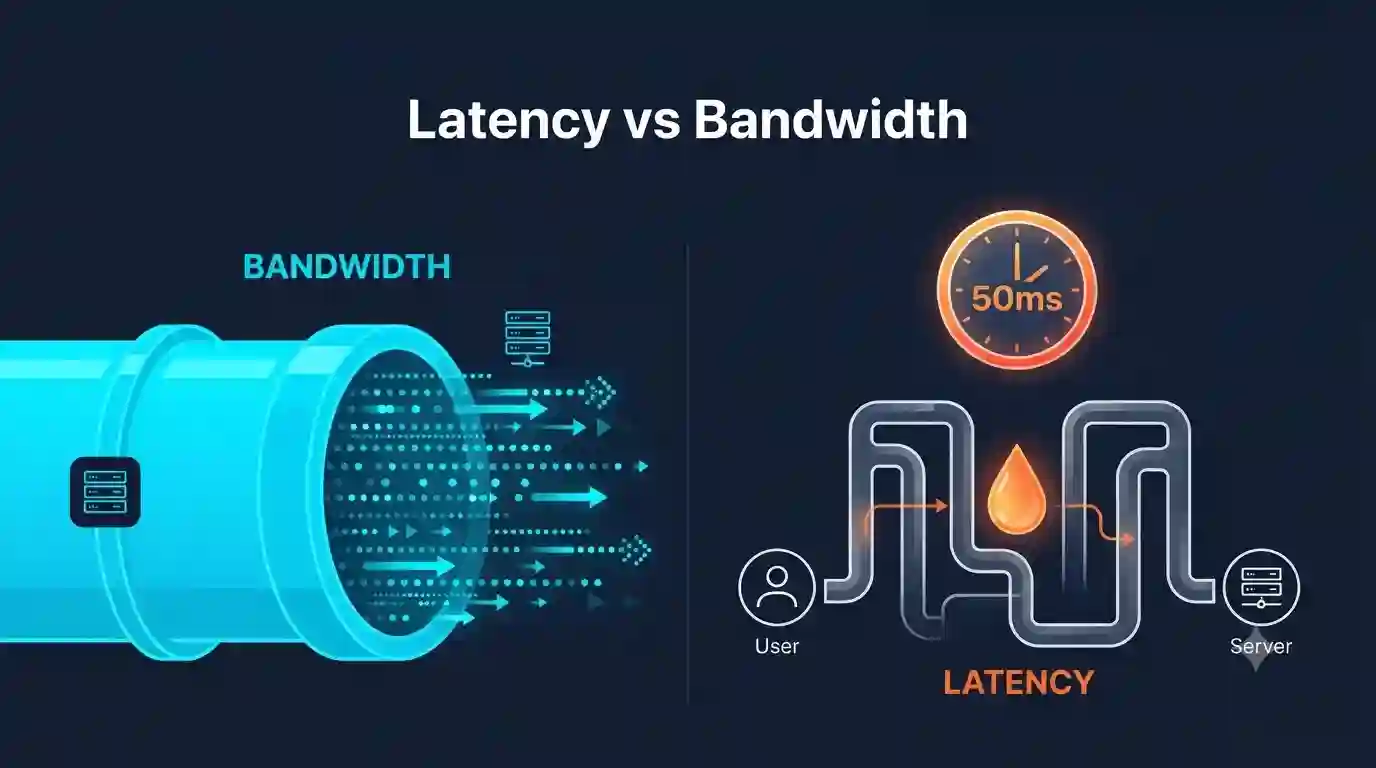
Latency measures how long data takes to start moving. The amount of data that may move simultaneously is measured as bandwidth. Picture latency as the wait time at a toll booth and bandwidth as the number of lanes on the highway: one shortens the wait, the other carries more cars at the same time.
Your internet plan promises 500 Mbps, yet video calls still freeze and games still lag. That frustration usually comes from mixing up two different things: latency and bandwidth. One tracks delay. The other tracks capacity. Confusing them leads people to upgrade the wrong service and waste money every month. This guide breaks down what is latency vs bandwidth in plain language, backed by real numbers, practical tools, and fixes you can apply today.
What Is Latency?
Latency is the time a single piece of data takes to travel from your device to a server and back. Networking teams call this round-trip time, and they measure it in milliseconds.
Picture sending a text message. The gap between hitting send and your friend’s phone buzzing is latency. Even on fast connections, that gap never hits zero, because data still has to travel through cables, routers, and satellites along the way.
Low latency feels instant and responsive. On a video call, high latency manifests as lag, delay, or that uncomfortable moment before someone answers. Cloudflare’s learning center explains latency as the response gap between a user’s action and a web application’s reply, and points to physical distance, network congestion, and the number of network hops as the main reasons that gap grows. This delay sits at the center of the latency vs bandwidth conversation: latency is about time, not volume.
What Is Bandwidth?
Bandwidth is the maximum amount of data your connection can carry every second. Providers measure it in megabits per second (Mbps) or gigabits per second (Gbps).
Picture bandwidth as the number of lanes on a highway. More lanes let more cars travel at once, but they don’t make any single car move faster. A wider connection moves more data at the same time; it doesn’t shrink the delay on any single packet.
Bandwidth decides how many devices can stream, download, or browse at once without slowing each other down. A household running ten connected devices needs far more bandwidth than a single person living alone. This capacity forms the other half of the latency vs bandwidth equation: bandwidth is about volume, not time.
Latency vs Bandwidth: The Core Difference (Comparison Table)
The clearest way to separate these two ideas is to place them side by side.
| Factor | Latency | Bandwidth |
|---|---|---|
| What it measures | Delay or response time | Data-carrying capacity |
| Unit | Milliseconds (ms) | Megabits per second (Mbps) |
| Simple analogy | Toll booth wait time | Number of highway lanes |
| Ideal range | Under 20-50 ms | 25 Mbps or higher per active device |
| Affects most | Gaming, video calls, VoIP | Streaming, downloads, uploads |
| Common test | Ping test | Speed test (download/upload) |
| Improved by | Wired connection, closer server, fewer hops | Fiber plans, higher-tier service, fewer connected devices |
| Feels like when poor | Lag, stutter, delayed response | Buffering, slow downloads, frozen video |
This table sums up the entire latency vs bandwidth debate in one glance: one governs speed of response, the other governs volume of traffic.
How Latency Is Measured
A simple test called a ping measures latency. A ping sends a tiny data packet to a server and times how long the round trip takes.
Numbers under 20 ms count as excellent. For the majority of jobs, including competitive gaming, anything between 20 and 50 ms works well. Once latency climbs past 100 ms, video calls start to feel choppy and fast-paced games become frustrating to play.
Round-trip time (RTT) describes a full ping cycle, from request to reply. Jitter, a close cousin of latency, tracks how much that delay swings from one packet to the next, and it matters heavily for smooth voice and video calls.
How Bandwidth Is Measured
Bandwidth splits into two separate numbers: download speed and upload speed. Download speed controls how fast you receive data, such as loading a page or streaming a show. Upload speed controls how fast you send data, such as posting a video or hosting a call.
In order to provide families with a useful benchmark rather than relying solely on conjecture, the FCC’s Broadband Speed Guide evaluates common online activities against the minimum download speed each one requires for seamless execution. Reading these numbers side by side makes the latency vs bandwidth comparison far easier to apply at home.
- Basic browsing and email: 1-5 Mbps
- HD video streaming: 5-8 Mbps
- 4K streaming: 25 Mbps
- Online gaming: 3-6 Mbps (latency still matters more here)
- Video conferencing: 1-4 Mbps
What Causes High Latency?
Several everyday factors push latency higher than it needs to be.
- Physical distance between your device and the server
- Network congestion during peak evening hours
- Extra hops between routers before data reaches its destination
- Wi-Fi interference from walls, microwaves, or neighboring networks
- Outdated routers running old firmware
- DNS lookup delays before a page even starts loading
Fixing two or three of these often removes most of the noticeable lag from everyday browsing and gaming sessions.
What Causes Low Bandwidth?
Bandwidth problems usually trace back to how the connection is shared or sold, not just distance.
- An internet plan that’s too small for the household
- Several devices streaming, gaming, or downloading at the same time
- ISP throttling during high-traffic hours
- Old cabling or outdated modems capping real-world speed
- Background apps or malware quietly consuming data
- Weak Wi-Fi signal between the router and the device
A speed test run at different times of day quickly reveals whether the real issue is the plan itself or the home network setup.
Latency vs Bandwidth: Which Matters More for Gaming, Streaming, and Video Calls?
Different online activities lean on different sides of this equation.
Online gaming needs low latency above almost everything else. A player with 300 Mbps bandwidth but 150 ms latency still sees enemies move a beat late.
Video and music streaming leans on bandwidth. Netflix, YouTube, and Spotify buffer content ahead of time, so a small delay barely registers, while a thin connection causes constant buffering.
Video calls on Zoom or Google Meet need both sides working together. Low latency keeps conversation natural, and enough bandwidth keeps video from freezing or dropping into a blurry, pixelated feed.
Large file downloads and cloud backups depend almost entirely on bandwidth, since the goal is moving a large volume of data rather than reacting instantly.
Real-Life Examples of Latency vs Bandwidth
Seeing these terms in action makes the difference click faster than any definition.
A gamer on a 1 Gbps fiber connection can still lag in a shooter game if the match server sits across the ocean, because distance drives latency no matter how much bandwidth sits behind it. Meanwhile, a household downloading a 50 GB game update finishes in minutes on high bandwidth, even with average latency, since large downloads barely notice small delays.
A remote worker joining a call from coffee-shop Wi-Fi might have plenty of bandwidth yet still suffer from high latency due to network congestion, causing their voice to trail behind their video. This single scenario captures why latency vs bandwidth confusion pushes people toward upgrading the wrong service entirely.
How to Test Your Latency and Bandwidth
Testing both takes less than a minute and needs no technical background.
- Open a free tool such as Speedtest by Ookla or Fast.com.
- Run the test while no one else streams or downloads on the network.
- Note the ping (latency), download speed, and upload speed on screen.
- Repeat the test at a different time of day to spot patterns.
- Compare the results against your provider’s advertised plan speeds.
Cloudflare’s own speed test goes further, since it also tracks loaded latency: the round-trip time data takes to reach the network and return while the connection stays busy transferring other traffic. That approach paints a more realistic picture than testing on a completely idle connection.
How to Fix Latency and Bandwidth Problems
Most connection complaints improve with a handful of straightforward changes.
- Connect gaming consoles and PCs directly with an Ethernet cable instead of Wi-Fi
- Restart the router and modem regularly to clear temporary congestion
- Update router firmware to the latest available version
- Choose game and app servers physically closer to your location
- Upgrade to a fiber-optic plan where it’s available, since fiber typically delivers lower latency than cable or DSL
- Set up Quality of Service (QoS) rules on the router to prioritize calls and gaming traffic
- Reduce the number of devices streaming during important calls or matches
- Contact the ISP directly if speed tests fall consistently below the advertised plan
How Latency and Bandwidth Affect Website Speed
Website owners deal with this same equation on the server side, not just the visitor side. A slow-loading page usually points to one of these two culprits.
High server latency delays the very first response a browser gets, pushing back metrics like Time to First Byte and hurting Core Web Vitals scores. A content delivery network (CDN) helps here by storing copies of a site closer to each visitor, which shortens the physical distance data has to travel.
Low bandwidth on the hosting side becomes obvious when many visitors load a page at once, especially pages loaded with large images or video. Compressing media, enabling caching, and choosing a host with generous network capacity all help avoid that bottleneck.
- Use a CDN to cut server-side response delay for visitors far from the origin server
- Compress and resize images before uploading them to the site
- Enable browser caching so repeat visitors reload pages faster
- Choose hosting with enough bandwidth for expected traffic spikes
- Monitor Core Web Vitals regularly, since both delay and capacity issues show up there
Search engines factor page speed into ranking signals, so a site that ignores either side of this equation risks losing both visitors and visibility.
Common Myths About Latency vs Bandwidth
A few misunderstandings keep costing people both money and patience.
Myth: More bandwidth automatically fixes lag. Bandwidth and latency solve different problems, so a bigger plan won’t shorten the distance data travels or clear up network congestion.
Myth: Latency doesn’t matter for casual browsing. Loading even a simple webpage involves dozens of small requests, so high latency still slows the page down, just less dramatically than in gaming.
Myth: Mobile data always trails home Wi-Fi. Modern 5G networks frequently beat older home connections on latency, even when the bandwidth numbers look similar on paper.
Myth: A wired connection stopped mattering years ago. Wi-Fi still adds extra latency and occasional packet loss compared with Ethernet, especially in homes with thick walls or heavy interference.
Latency vs Bandwidth: Which Should You Prioritize?
The right priority depends entirely on how the connection gets used most.
- Choose low latency first if the household games competitively or relies heavily on live video calls.
- Choose high bandwidth first if multiple people stream 4K content or download large files often.
- Balance both if the household mixes remote work, streaming, and gaming across several devices.
- Test the current connection before upgrading anything, since many “slow internet” complaints turn out to be a router or Wi-Fi issue rather than the plan itself.
Once the latency vs bandwidth picture is clear, every future upgrade decision gets simpler and cheaper.
Frequently Asked Questions
What is the main difference between latency and bandwidth?
Latency measures delay in milliseconds, and bandwidth measures data capacity in Mbps. Latency vs bandwidth comes down to speed of response versus volume of data moved, and both numbers matter for a smooth connection.
Can you have high bandwidth and high latency at the same time?
Yes. A connection can offer 500 Mbps bandwidth and still show 150 ms latency if the server sits far away or the network path passes through many hops. This combination often confuses people into blaming their internet plan instead of the real cause.
Does more bandwidth reduce latency?
No, more bandwidth does not reduce latency. This ranks among the most common latency vs bandwidth misunderstandings, since bandwidth adds capacity, not speed, and rarely fixes a lag problem caused by distance or congestion.
What is a good latency and bandwidth for gaming?
Competitive gamers should aim for latency under 30 ms and bandwidth of at least 15-25 Mbps. Latency matters far more than raw bandwidth once the connection clears that baseline.
Why does my internet feel slow even with high bandwidth?
High latency, Wi-Fi interference, or an overloaded router can make a high-bandwidth connection feel sluggish anyway. Running a quick ping test alongside a speed test usually reveals the real bottleneck.
How can I lower my latency without changing my internet plan?
Switch from Wi-Fi to a wired Ethernet connection, restart the router, and pick servers closer to your physical location. These three steps often lower latency more than any plan upgrade would.
Final Thoughts
Latency and bandwidth solve two separate problems, and knowing the difference saves both money and frustration. Test your connection, match the fix to the actual cause, and upgrade only the specific side of your internet that’s genuinely holding you back.
Run a speed and ping test today, compare the results against the table above, and share this guide with anyone still confusing a slow connection with a small one.