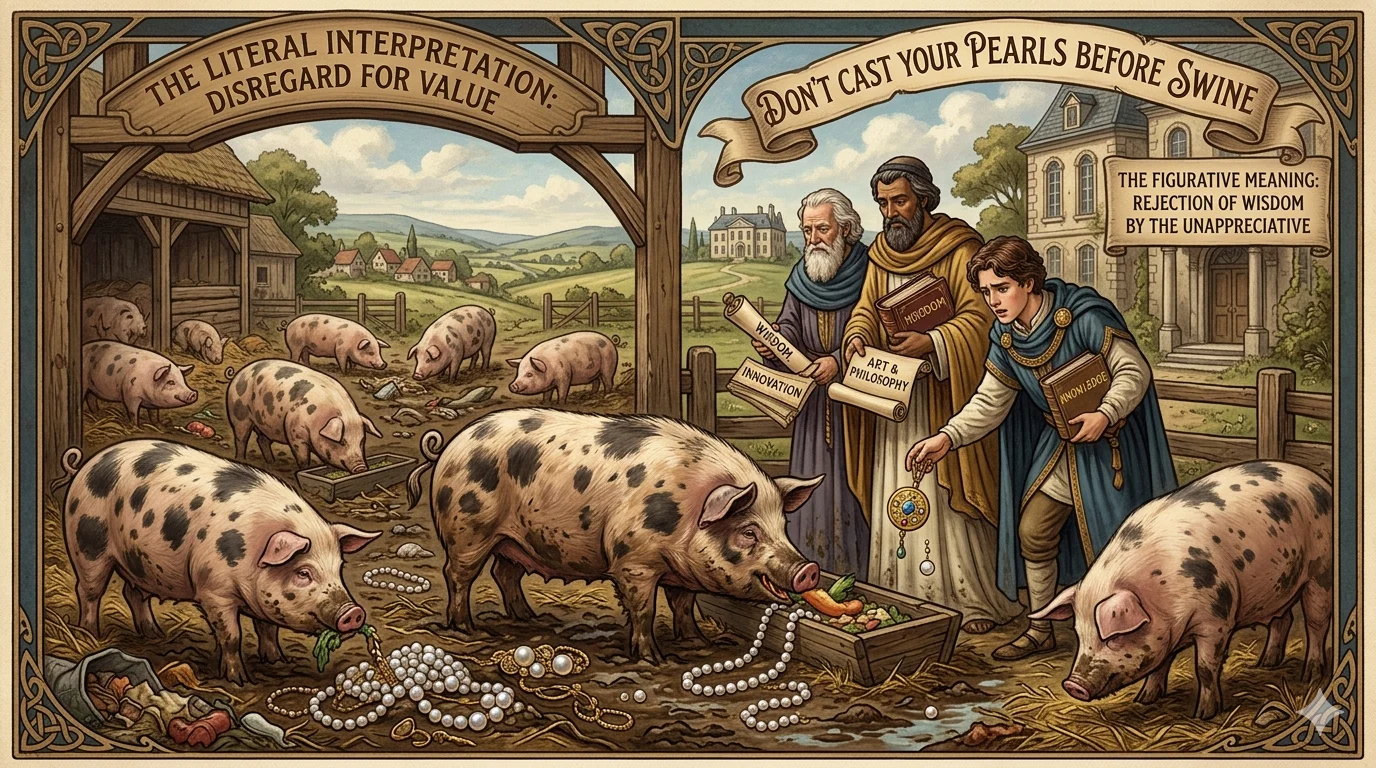
What Does “Pearls Before Swine” Mean? Phrase + Comic Strip Explained
You’ve handed your best effort to someone who didn’t notice. You’ve shared real ideas with people who walked away mid-sentence. You’ve given energy to places that returned nothing. That experience has a name — pearls before swine. The phrase carries two thousand years of human truth inside four words. It also happens to be the title of one of the most cleverly written comic strips in daily circulation. Both meanings deserve a proper explanation.
What Does “Pearls Before Swine” Actually Mean?
Pearls before swine describes the act of offering something genuinely valuable to someone completely unable or unwilling to recognize its worth. The something might be advice, creative work, affection, time, or effort — and the person receiving it either ignores it, dismisses it, or treats it carelessly.
The phrase carries no anger toward the other person. It carries a warning about the direction of your own generosity. Spending real value on the wrong audience doesn’t punish them — it only costs you.
Understanding this phrase helps explain a feeling most people have experienced but never quite had words for. You gave something meaningful. It landed nowhere. That gap between what you offered and what was received — that is the whole meaning.
Where Did the Phrase “Pearls Before Swine” Come From Originally?
The phrase traces directly to the Gospel of Matthew, chapter 7, verse 6 in the Bible. The original teaching instructs listeners not to give what is sacred to dogs or throw pearls before swine, warning that doing so causes the pigs to trample the pearls and turn on the giver.
The imagery works because it captures a visible, concrete scene. Pigs have no capacity to value pearls. They cannot eat them, use them, or understand why someone placed them on the ground. The pearls still hold their worth — the problem is entirely about placement, not quality.
This passage comes from the Sermon on the Mount, one of the most widely studied sections of the New Testament. The teaching sat in religious texts for centuries before it moved into everyday speech as a standalone expression.
What Does “Don’t Cast Your Pearls Before Swine” Tell You About Judgment?
The full instruction — do not cast your pearls before swine — is less about protecting your pearls and more about developing honest judgment about your audience. The warning is forward-looking, not reactionary.
Before you share something of real value, the phrase asks you to pause and assess who is actually in the room. Not everyone who appears receptive actually is. Not every relationship, workplace, or conversation deserves the full weight of your best thinking.
Casting pearls before swine is not always caused by other people’s failings. Sometimes it happens because the giver has not stopped to ask whether this person, this moment, or this situation actually calls for what they are about to offer.
How Do People Use “Casting Pearls Before Swine” in Real Life Today?
Modern usage of the phrase spans personal conversations, professional settings, creative fields, and therapeutic language. It appears when someone describes exhausting emotional labor spent on unresponsive relationships. It comes up when a creator describes sharing original work with audiences who don’t engage.
Situations where casting pearls before swine appears most often:
- A skilled employee presenting fresh ideas to management that ignores every suggestion
- A writer sharing detailed creative work in spaces that value only surface-level content
- A person giving genuine emotional honesty to someone emotionally unavailable
- A teacher preparing deeply for a class where no student arrives ready to participate
- A mentor offering hard-earned experience to a mentee who never applies any of it
The phrase remains in active use because the experience it describes never stopped being real. Every generation meets situations where the gap between the value offered and the value received becomes impossible to ignore.
What Is the Pearls Before Swine Comic Strip?
Pearls Before Swine is a syndicated daily comic strip created by Stephan Pastis that runs in newspapers and online through platforms like GoComics. The strip launched in 2002 and built a reputation for dark humor, sharp wit, and a distinct willingness to mock the conventions of newspaper comics themselves.
The strip takes its name directly from the ancient proverb — and the connection runs deeper than just a clever title. Much of the humor inside pearls before swine comes from characters who repeatedly attempt to share some form of wisdom, decency, or insight with others who completely fail to grasp it.
The title is the thesis. Every strip argues, in some small way, that the world keeps asking you to share something real with audiences who may not be ready for it.
Who Created the Pearls Before Swine Comic and What Is His Background?
Stephan Pastis created pearls before swine after a career path that started in law. He worked as an attorney before the strip gained enough traction to support a full creative career. That background shows up in the humor — precise, structured, argument-aware, and comfortable with absurdity.
Pastis does something unusual for a cartoonist: he writes himself into the strip regularly as a character. The fictional Stephan Pastis exists inside pearls before swine as a flawed, self-aware narrator who frequently gets called out by his own characters for bad writing choices.
That layer of meta-commentary gives the strip something most newspaper comics never attempt — a running conversation between the creator and the work itself, visible to every reader.
Who Are the Main Characters in Pearls Before Swine?
The strip centers on a small cast of recurring characters whose clashing personalities drive most of the humor. Each character represents a distinct worldview, and the comedy often comes from those worldviews colliding without resolution.
Main characters in pearls before swine:
| Character | Personality | Role in the Strip |
|---|---|---|
| Rat | Cynical, selfish, brutally blunt | Delivers dark observations about human behavior |
| Pig | Naive, kind, completely literal | Takes everything at face value, often misses the point |
| Goat | Thoughtful, reasonable, often exasperated | Serves as the voice of perspective |
| Zebra | Gentle, idealistic, frequently disappointed | Tries to reason with predators who want to eat him |
| Crocodiles | Dim-witted, always hungry | Comic villains who never quite succeed |
| Guard Duck | Aggressive, military-minded | Pig’s duck who solves problems through force |
| Stephan Pastis | Self-deprecating, self-aware | The cartoonist who appears as a character in his own strip |
What Makes the Pearls Before Swine Comic Stand Out From Other Strips?
Most newspaper comic strips aim for warm, family-friendly humor that offends nobody and leaves readers mildly amused. Pearls before swine chose a different lane entirely and stayed in it for over two decades.
What separates pearls before swine from other comic strips:
- Dark, satirical humor that trusts readers to handle uncomfortable truths
- Recurring wordplay jokes built across multiple panels with unexpected punchlines
- The creator appearing as a character inside his own work — a rare structural choice
- Direct mockery of other comic strips and newspaper publishing conventions
- Characters who exist in a world that refuses to improve no matter what they try
- A consistent tension between idealism (Pig, Zebra) and cynicism (Rat) that never resolves
The strip treats its readers as adults who appreciate wit over warmth. That decision built a deeply loyal audience that has followed the strip from print newspapers to daily online platforms.
Where Can You Read Pearls Before Swine Today?
Pearls before swine runs daily on GoComics, which hosts the full archive going back to the strip’s 2002 launch. Readers can access current strips free of charge and browse the historical archive through the platform’s subscription option.
The strip also appears in syndicated newspapers across the United States and internationally. Stephan Pastis maintains an active presence on social media where he shares strips and interacts directly with readers, making the strip’s community unusually accessible for a newspaper comic.
Book collections of pearls before swine publish regularly through Andrews McMeel Publishing, gathering multi-year runs into single volumes for readers who prefer a physical reading experience.
Why Has Pearls Before Swine Stayed Relevant for More Than Twenty Years?
Most comic strips fade within a decade. The creative voice either softens, the cultural references age badly, or the audience moves on. Pearls before swine avoided all three problems through a combination of consistent tone and willingness to keep evolving.
The strip’s core observation — that the world rewards mediocrity while genuine effort frequently goes unappreciated — ages exactly zero percent. That truth stays current because it reflects something structurally real about human interaction, not something tied to a specific cultural moment.
Pastis also kept the strip sharp by never letting it grow comfortable. The meta-humor, the wordplay structures, and the creator’s willingness to make himself the butt of jokes all signal a creative who takes the work seriously enough to keep pushing it.
How Does the Comic Strip Title Connect to the Original Biblical Meaning?
The connection between the comic title and the ancient proverb is not coincidental or decorative — it’s the entire premise. Pearls before swine as a strip is built on the same tension the proverb names: the gap between what someone offers and what the recipient can receive.
Pig offers genuine kindness to a world that takes advantage of it. Zebra offers reason to crocodiles who want to eat him. Goat offers perspective to Rat, who ignores it. Even the fictional Pastis offers creative effort to characters who complain about the quality of the strip they live in.
Every strip is, in miniature form, an enactment of the proverb. The title is not just a name — it is the thesis running through every panel the strip has ever published.
What Can “Do Not Cast Your Pearls Before Swine” Teach You Right Now?
The instruction do not cast your pearls before swine is not permission to become closed off or stingy with your abilities. It is permission to be honest about where your energy actually produces something.
Not every audience deserves your best presentation. Not every relationship calls for maximum emotional investment. Not every room is ready for your most original ideas. Recognizing that distinction protects both your work and your wellbeing.
The phrase has lasted two thousand years because it describes a recurring human pattern — generosity misread as weakness, effort mistaken for availability, real value offered to spaces that cannot hold it. Learning to read your audience before you give your best to them is one of the most practical things an ancient scripture can still teach you.
6 Most Asked Questions About Pearls Before Swine
1. What does pearls before swine mean in simple terms? It means offering something genuinely valuable — time, ideas, effort, or care — to a person or situation completely unable to appreciate or use it. The value of what you offer doesn’t change. The problem is the mismatch between what you give and where it goes.
2. Where does the phrase “don’t cast your pearls before swine” come from? The phrase originates from Matthew 7:6 in the Bible, part of the Sermon on the Mount. The original teaching uses the image of throwing pearls into a pig pen — the pigs trample them, not out of malice, but because they have no capacity to recognize their value.
3. The Pearls Before Swine comic strip is written and illustrated by who? Stephan Pastis created the strip and continues writing and drawing it today. He began his career as an attorney before shifting full-time to cartooning. He is unusual among comic strip creators for regularly writing himself into the strip as a character.
4. When did the Pearls Before Swine comic strip first appear? The strip launched in 2002 and has run continuously in syndication ever since. It currently appears in hundreds of newspapers across the United States and internationally, as well as daily on GoComics.
5. What is the main theme of the Pearls Before Swine comic? The strip examines the recurring gap between what people deserve and what they actually receive. Dark humor, wordplay, and a cynical-but-honest worldview drive most of the jokes. The title reflects the central tension — effort and value offered into spaces that cannot hold them.
6. Is casting pearls before swine always a negative thing? Not entirely. The phrase describes a pattern worth recognizing and adjusting, but it doesn’t call the person giving poorly for it. Recognizing when you are casting pearls before swine is actually a sign of growing self-awareness. The phrase teaches discernment, not cynicism.
Your Next Step With Pearls Before Swine
Two thousand years of human wisdom compressed into four words is not something to scroll past. Whether the phrase lands for you because of a relationship that drained you dry, a workplace that ignored your best work, or simply because you’ve finally found language for something you’ve felt for years — sit with it.
If you want to see that wisdom turned into daily humor, start reading pearls before swine on GoComics today. Pull up the archive and give yourself an hour with Rat, Pig, and the world they can’t stop commenting on. You’ll understand immediately why the strip earned its name.